
How TPRM Changes When Agents Handle the Execution
Enterprise TPRM has outgrown the manual model. Vendor portfolios are larger and more complex than ever before: more vendors integrated into core systems, holding or touching data, and relied upon for critical workflows. The risk surface has ballooned, and regulatory scope has widened to match.
At today's scale, staying ahead of the vendor workload can consume a GRC team's week, leaving the essential risk-reducing work that defines a strong TPRM program consistently deferred. A new operating model is needed, one where execution runs continuously through AI agents, giving teams the hours and the inputs to build a genuinely proactive and continuous vendor risk program.
Execution blocks judgment
Every TPRM program involves two streams of work: execution-based work and judgment-based work. Execution is process-defined and high-volume, which involves sending questionnaires, reviewing answers, chasing vendors, writing up approvals. Judgment is what GRC experts specialize in; work like interpreting and prioritizing findings, deciding what the business can accept as risk, and calibrating how the program tiers and escalates vendors.
An organization's ability to manage third-party risk depends on GRC teams having enough time for judgment and analysis. However, with manual TPRM processes, the time for judgment shrinks to whatever is left after the process work is finished: from the initial vendor tiering and criticality decision that can’t start until the business owner is chased, to the finding remediation that relies on someone reading 100+ vague questionnaire answers.
At Enterprise scale, the problem compounds as every new vendor adds yet more execution work. Portfolios grow, regulatory scope expands, and the process load grows with both. The work GRC teams were hired to do gets squeezed further, and with it, the business’s capacity to stay ahead of third-party risk.
Hiring may seem the obvious response but, even if it were possible to grow headcount at the same rate as the workload - it does not break the pattern. Spreading the work among more people means time lost to handovers and gaps for findings to slip through. Larger teams also experience greater knowledge fragmentation, which stunts long-term program improvements. Beyond today's volume and regulatory pressure, headcount is at best a band-aid, and at worst a risk of its own.
What AI agents change
When AI agents support TPRM workflows, this blocking gate disappears. Execution no longer has to be completed by the team before judgment can start.
AI agents take action by definition: they respond to a trigger event and autonomously run multi-step workflows. They apply the organization-specific criteria they’re given, make decisions within their scope, and produce outputs that are review-ready for humans to act on.
When applied to TPRM:
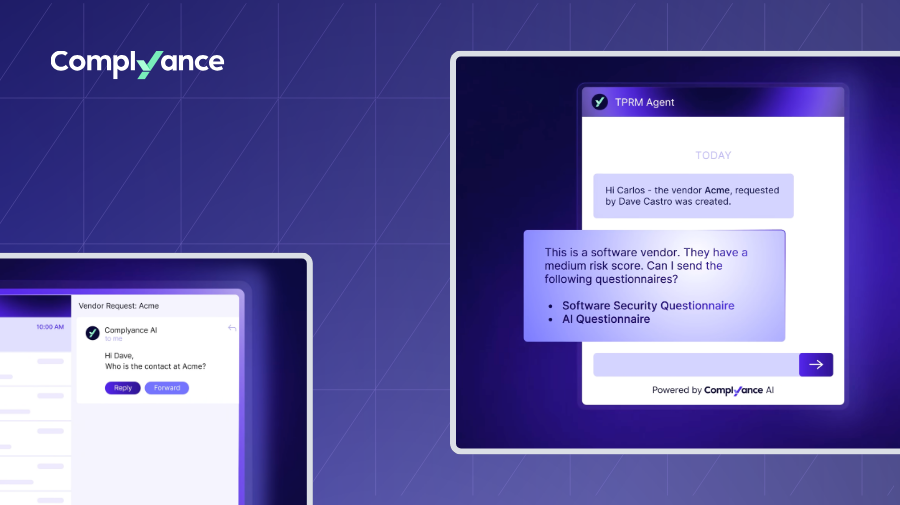
Intake becomes judgment-ready by default. When a new vendor request arrives - AI agents pick it up. They review the details of the request - follow up with the business owner if context is missing - and triage the request. The output is a tailored assessment pathway for every vendor.
The GRC team’s first task is to evaluate the proposed tier and assessment scope. They see the agent’s full reasoning and all context - without hunting for it.
Review focuses on findings, not raw answers. When the vendor returns their completed questionnaire, the agent immediately begins reviewing. Answers are assessed against the organization's custom risk criteria and any findings are flagged.
The GRC team is notified with a clear view of the vendor’s risk posture and full visibility into potential exposure. Remediation can start at the top of the list.
Monitoring runs continuously, not on a calendar. Once a vendor is approved and onboarded, monitoring runs continuously. Reassessments are triggered on new signals: a risk posture change, a new external finding, a certification expiry.
Coverage becomes continuous in practice. Vendor risk gets reassessed when something actually changes, not when a calendar reminder fires.
With the operating model flipped, the judgment, analysis, and tangible actions needed to manage third-party risk become the GRC team's primary work. Moving to this new model is the only way TPRM teams will keep pace with the growing vendor risk landscape.
.png)
The second-order shift
The benefits compound when TPRM teams enter a new operating model with AI agents. With the hours and the inputs to do the work they specialize in, GRC teams can finally turn to the risk-reducing initiatives they have been promising the board for years - such as extending review beyond just critical vendors or implementing more nuanced remediation guidelines.
The economics of those improvements change too. The criteria AI agents apply during their review are codified, so they can be easily improved upon in plain language in the agent settings. Once changes are made, agents apply them consistently across every future review. What used to be a months-long rollout becomes a single update, live across the portfolio the moment it's approved.
The manual model could not produce this outcome regardless of discipline, tooling, or team size. Execution-heavy programs are structurally capped at the amount of judgment work they have time for, and therefore at the amount of risk they can see and manage. Agents lift both caps at once.
The question for Enterprise GRC and InfoSec leaders is no longer whether to adopt AI agents. It is how quickly they can get there. The execution load is not stabilizing. The regulatory picture is not simplifying. The headcount is not arriving. Every quarter spent scaling the manual model is a quarter of accumulating unmanaged risk.
Complyance is built around this new model. Teams on the platform run the TPRM program they were hired to build: getting ahead of vendor risk, scaling portfolios without scaling headcount, and walking into board meetings with a live, sourced picture of third-party risk.
See the workflow in production at Complyance, from intake through continuous monitoring.



