
What Is the Best AI Governance Platform for Enterprise?
When leadership asks about AI, the question it wants answered is whether the company does what its AI policy says, for the AI it builds and the AI inside its vendors' products. The best AI governance platform for an Enterprise is the one that, alone or alongside the systems you already run, can show four things for every AI system in use. It's on an inventory with a named owner, controls carry out the AI policy, any vendor AI behind it has been reviewed, and the evidence maps to ISO 42001, the NIST AI RMF, and the EU AI Act.
With those in place, someone can follow any line of the policy to a control with an owner and to the evidence behind it. Four approaches get there, each from a different starting point. They're a policy-led program, privacy-led tools extended to AI, a dedicated AI governance platform, and control-based governance in an Enterprise GRC platform.
What belongs on an Enterprise AI inventory?
An Enterprise AI inventory lists every AI system in use, including AI embedded in software you buy, with a named owner on every entry. Each entry records the system's ownership, version history, and deployment status, so a model your data science team trained and a writing assistant switched on inside a purchased HR system belong on the same list.
TechTarget's 2026 guide to AI governance platforms widens that list to data and vendors. It describes the platform as the working system of record for a business's AI use, one that inventories models, applications, agents, data, and vendors. With vendors on the same list, the review of their AI starts from the same place as the review of your own.
Finding every system is harder than listing the ones people declare. AI arrives in a software update to a tool the business already bought, or as an agent a team sets up in an afternoon, and neither comes with an intake form. An inventory built only from what teams report will miss systems like those, so it needs a way to discover AI as well as a way to declare it.
Why do controls decide whether an AI policy holds?
AI governance programs typically start with a policy, sometimes with a framework on top of it. The policy says what the company commits to, and controls are how anyone finds out whether that's happening. A control turns a line of the policy into something someone can check. It has an owner, a test, and evidence that it happened, and it's linked to the risk it reduces.
If the AI policy requires a risk review before any new AI use case goes live, the control is the step that checks the review took place. It records who approved it and keeps the evidence where an auditor can find it. That control earns its place on the urgent deployment, when a team up against a deadline has the most reason to skip the review. We've written more about the gap between AI policy and enforcement.
Every control needs an owner, and so does the program around them. When nobody is accountable for AI governance as a whole, each control can have an owner while the gaps between them, such as an AI use case nobody registered, belong to no one.
How should AI governance cover the AI inside your vendors' products?
AI you buy is governed through due diligence on each external model and AI-enabled product. The review covers who owns it, how it uses your data, what the contract says, and how the vendor tells you when it changes. TechTarget lists third-party AI risk as a core capability of an AI governance platform in those terms, so vendor AI is part of the job whichever approach you choose.
For a vendor that has added an AI assistant to its platform, the questions sit next to the security questions you already ask. Who at the vendor owns the AI feature? Does it use your data to train or improve its models, and does the contract allow that use? Will the vendor tell you before the model or its use of your data changes? There are more AI questions worth adding to vendor assessments if you're building the question set from scratch.
The output works like any other vendor review. Where an answer falls short of your criteria, it becomes a finding for a person to judge. Where the gap needs fixing, it gets a remediation action with an owner and a due date. That puts vendor AI in the same risk picture as your own systems, ready to be mapped to the frameworks your company is held to.
Which AI frameworks does the platform need to produce evidence for?
An Enterprise AI governance platform needs to produce evidence for whichever of the EU AI Act, the NIST AI RMF, and ISO/IEC 42001 apply to you, and each asks for a different kind of evidence.
The EU AI Act sorts AI systems into four risk levels (unacceptable, high, transparency, and minimal or no risk), so the first record it calls for is a classification of each system on the inventory. Its dates then decide when the records for each class have to be ready. According to the European Commission's AI Act page, the AI Omnibus entered into force on July 27, 2026. Stand-alone high-risk systems in areas such as employment, education, and critical infrastructure come under the rules from December 2, 2027, and AI built into regulated products from August 2, 2028. Prohibitions on eight AI practices and the AI literacy obligations have applied since February 2, 2025, so evidence for those is already due. A ninth prohibition added by the Omnibus comes into effect in December 2026.
NIST's AI Risk Management Framework, released in January 2023, is voluntary, so its evidence is the mapping your program chooses to keep against it. That mapping has to follow a moving framework. NIST added a Generative AI Profile in July 2024 and says AI RMF 1.0 is being revised, so a platform's NIST content has to keep pace with the current version.
ISO/IEC 42001:2023 defines requirements for establishing, implementing, maintaining, and continually improving an AI management system, including AI risk assessment and AI impact assessment, according to ANAB, the ANSI National Accreditation Board. Certification applies to the organization's management system, verified by an independent certification body, not to a product or service. The evidence is the management system's own records, those assessments included.
The three can share one body of evidence when a single assessment of each system is mapped to all of them and the mappings stay current as the frameworks change.
How do the four approaches to AI governance compare?
Each approach can work toward every criterion, and each starts from a different team. A review committee can run a policy-led program from the first week. A privacy-led tool builds on the privacy team's data records, while a dedicated AI governance platform gives an AI governance function its own registry. Control-based GRC puts AI inside the controls and vendor reviews the compliance program already runs.
Three of the four approaches are software, and they're at different stages. TechTarget describes inventory, policy mapping, and audit evidence as relatively mature, while runtime controls, shadow AI discovery, and agent governance are developing quickly and remain less consistent across products.
A policy-led program
Every approach starts from a written policy, and a policy-led program runs AI governance through the policy itself, with a review committee, owners who check it's followed, and a tracker. It needs no new tool, and it gives AI governance an owner from the first day. Teams tend to move on when evidence requests arrive faster than anyone can assemble the answers by hand, or when leadership wants a current view rather than the one from the last review.
Privacy-led tools extended to AI
Where the privacy team already maintains data inventories and runs privacy assessments, a privacy-led tool lets AI reviews start inside records and workflows the business already uses. It's organized around personal data, so it's strongest where an AI system's risk is a data question, such as what personal data the system uses, on what basis, and who it's shared with. An AI system that handles no personal data, or a risk that sits in the model rather than the data, such as accuracy that drifts after launch, can fall outside the records the tool was built to keep. Ask how it handles both before you extend it to the whole AI portfolio.
Dedicated AI governance platforms
Dedicated AI governance platforms fit best where AI governance is a function in its own right, with a team whose job is the AI portfolio. That portfolio covers AI built in-house and AI arriving inside purchased software. Analysts describe it as an emerging market.
The trade-off is a second system of record. The AI policy's controls, the reviews of vendors' AI, and the risks they raise live in the AI platform, while the rest of the compliance program's controls, vendor reviews, and risk register live in another. The two have to be integrated or kept in step by hand. That works well when a dedicated team owns the AI portfolio, and it's more to run when the same lean GRC team covers both.
Control-based governance in an Enterprise GRC platform
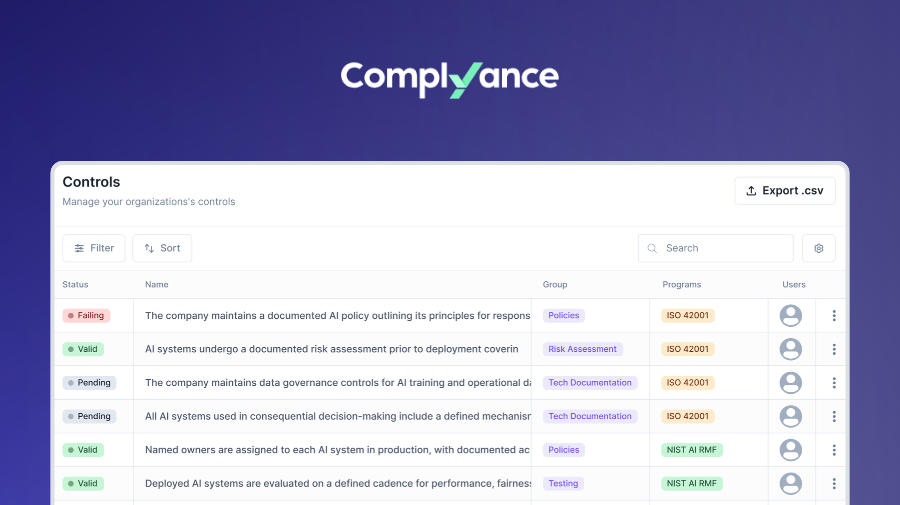
Control-based governance treats each line of the AI policy the way the compliance program already treats a requirement, as a control with an owner, a test, and evidence. Complyance, an AI-native Enterprise GRC platform, takes this approach, so AI governance runs on the controls, risks, vendors, and policies your program already has, rather than as a separate program. Off-the-shelf, configurable controls cover ISO 42001, the NIST AI RMF, and the EU AI Act, with each framework's controls kept separate and evidence cross-mapped where they overlap. A policy line such as the pre-launch risk review is versioned and approved in Policies and linked to its control in the Controls module. The Evidence Review Agent checks that control's evidence against criteria your team sets, for example that the review is signed off by the use case owner and dated before launch, whether a control owner uploaded it or an integration pulled it.
Vendor AI runs through the Vendors module in the same way. When a vendor whose product uses AI submits its questionnaire, the Vendor Questionnaire Review Agent reviews each answer against the criterion your team wrote for that question, and flags what the vendor leaves out as well as what it discloses. One such criterion reads "the contract states customer data is not used to train the vendor's models." Findings appear as soon as the vendor submits. A material change, such as a significant model update or a new use of your data, triggers a re-assessment that's tracked like the first. When a vendor finding needs to become a risk, a person approves it and the Vendor Risk Creation Agent drafts the risk description and treatment plan, with the vendor and the risk linked both ways. Your team sets the criteria, chooses which steps need sign-off, and makes the final call on findings, risks, and vendors.
Complyance doesn't sit in the path of live AI requests, where runtime guardrails are a separate category. Vendor AI is tracked in the Vendors module, and an inventory of in-house AI systems may sit in another system alongside it.
How do you choose the right AI governance approach?
Start with the team that already owns AI governance, because each approach is strongest where it starts. Then pick the approach whose evidence a reviewer outside the GRC team can follow and sign off.
One real AI use case, run through each shortlisted approach, will tell you which that is. Pick a high-risk system rather than a clean demo, and add one vendor's AI product to the same run, so the vendor review is tested on the same terms as your own systems. Take each run as far as the approach goes, from finding the system to classifying its risk, mapping it to your frameworks, and producing the evidence. That evidence can be an exported package or a folder assembled by hand. Then ask a reviewer from risk or legal to complete the sign-off without help.
If that reviewer can follow a line of the policy to its control and its evidence, the board can too, and so can the people whose data those systems handle. That's also the fair test for Complyance, which keeps the controls, policies, and vendor reviews for that run in one place.
See how Complyance traces each line of your AI policy to a control, an owner, and its evidence. Book a Demo


