The AI risk you're most exposed to could already be in your approved vendors list: added to products without notifying you, training on your data, with no obligation to disclose it. Complyance finds that exposure and assesses it with AI-specific questionnaires, giving you full visibility without changing your whole process.


































.png)

.png)
Schedule a 30 min demo
Practical thinking on AI governance, vendor risk, and what Enterprise teams are getting wrong.
Most organizations don't have a clean answer to this, which is part of the problem. Vendors aren't always proactive about disclosing material changes, and contracts written before AI was a factor rarely require them to be. Complyance treats a material AI change as a defined trigger for re-assessment, so your vendor records reflect how vendors actually operate today, not how they operated at onboarding.
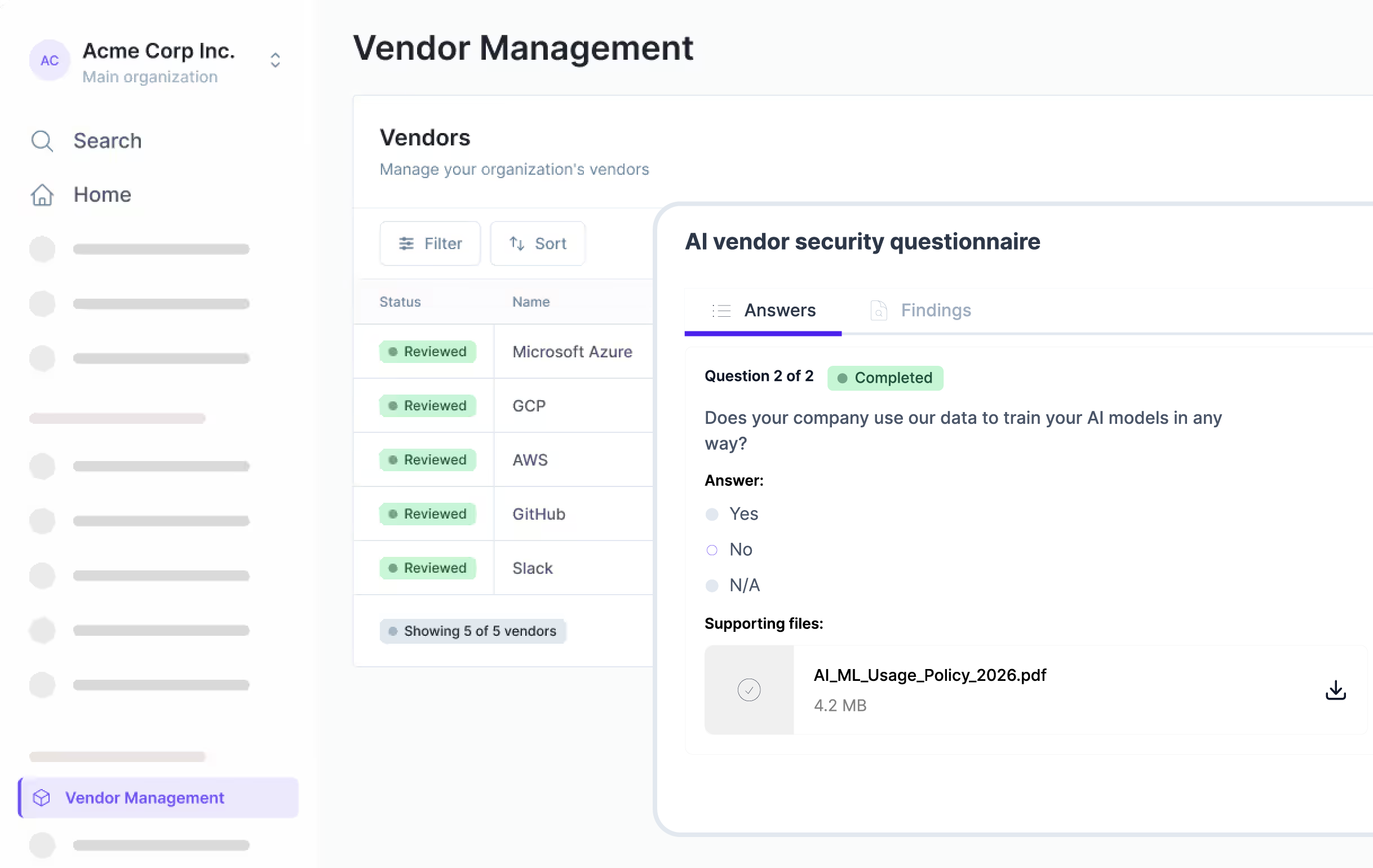
Standard assessments were built for security and data handling risk, not for questions like what a model was trained on, who's accountable when outputs fail, or whether your data is being used to improve a vendor's model. Complyance's AI vendor questionnaire was purpose-built for this risk profile, covering model inputs, human oversight, output auditability, and AI-specific incident handling.
The Questionnaire Review AI Agent assesses each response against a defined risk profile, looking for what's evaded as well as what's disclosed. Vendors that sidestep oversight questions or acknowledge unrestricted model training on customer data surface as findings automatically. Your reviewer sees an assessed response with gaps already identified, not a raw document to work through manually.
No. Your compliance data is yours. Complyance AI agents are domain-trained by compliance experts, not on customer data. They operate within tight inputs and tight outputs, with guardrails that prevent outputs outside their defined scope. This is why Enterprise teams like CVS Health and Dropbox trust Complyance AI in production: structural integrity is non-negotiable at that scale.
A vendor that adds a new AI use case, updates their model significantly, or introduces a new data input after onboarding shouldn't carry a risk rating from before those changes existed. Complyance gives teams the workflow infrastructure to act on material changes quickly, so when a vendor discloses an update, re-assessment is structured, tracked, and auditable rather than ad hoc. Your vendor records reflect how vendors actually operate, not how they did at intake.