
What GRC Platform Should a Large Enterprise Use?
At a large Enterprise, a new GRC platform has to fit a program that's already complicated. There are several frameworks to maintain, entities that each need their own records as well as a combined view for the board, and control owners across the business who take part without living in the tool. And it has to be something the team you have can run.
That's why there's no single best GRC platform for a large Enterprise. The right choice depends on what's driving the purchase, what you already run, and how much day-to-day work your team can take on. The options fall into four broad approaches (staying manual in spreadsheets, a legacy Enterprise GRC platform, a startup compliance tool, or agent-led GRC), and each is strongest in a different situation. The clearest differences show up in how each one handles multiple frameworks and entities, changes made without code, and control over its AI.
The demands on Enterprise GRC programs keep growing. Nearly 90% of executives in PwC's Global Compliance Survey 2025 said their compliance responsibilities had widened over the previous three years, and the added work usually lands on small teams with big jobs. It's a large part of why lean compliance teams are burning out.
Why is there no single best GRC platform for a large Enterprise?
The market is too wide, and Enterprises' needs too different, for one platform to fit everyone. Gartner counts more than a hundred companies selling GRC tools and notes that buyers struggle to match a tool to their use case.
What analysts say about the GRC market
Gartner's research shows both how crowded the field is and how often buyers end up unhappy with what they chose. Its October 2025 Magic Quadrant for GRC Tools, Assurance Leaders evaluates just 16 of those platforms. Owning one doesn't settle the question either. 85% of Gartner's assurance clients run more than one GRC tool, yet only slightly more than half of Enterprise risk management users are satisfied with what they have.
Those numbers point to the same lesson. A platform succeeds when people outside the GRC team use it and when it connects to the systems the company already runs, more than when it has the longest list of modules. The old line between Enterprise suites and compliance automation tools is also blurring, so a category label says less than it used to about what a product can do.
Which four tests should a lean team at a multi-entity Enterprise run?
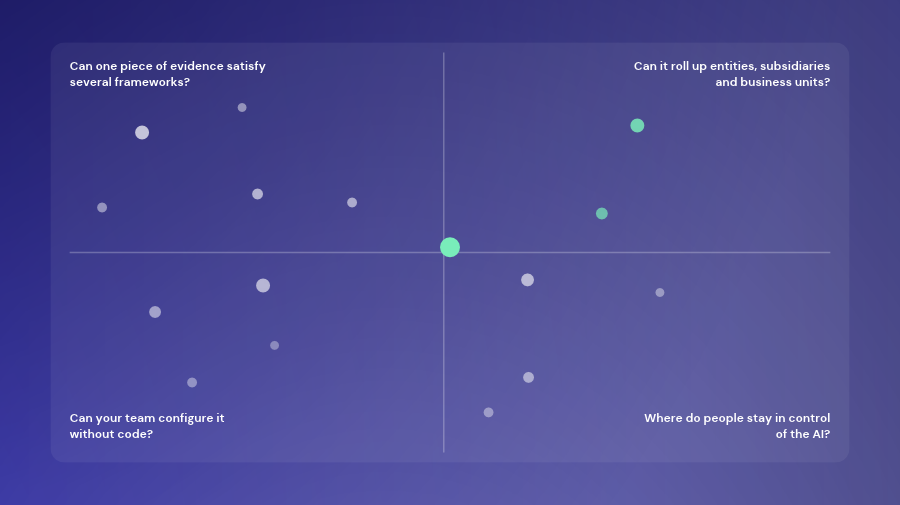
Four tests do the most to separate the approaches. Can one piece of evidence serve several frameworks? Do risks and controls roll up cleanly across entities? Can your team change the platform without code? And do people stay in control of its AI?
Each one reflects work your team does every week. Keeping patients', customers', and employees' data safe depends on hundreds of small controls working across every entity, and the platform is where your team sees whether they are. A prepared demo won't show you that, so each test below ends with something to ask the platform's team to show you live, using your own data.
Can one piece of evidence satisfy several frameworks?
On the right platform, yes. Different frameworks and regulations often ask for the same safeguard in different words. A platform that manages each framework's controls in one place and cross-maps evidence where requirements overlap saves your team from doing the same work several times, while each framework keeps its own controls and wording.
Take a quarterly access review for a core system. SOC 2, ISO 27001, and HIPAA each expect you to control who can reach sensitive data and to review that access periodically.
With cross-mapping, the reviewer signs off once, the evidence is stored once, and the matching SOC 2, ISO 27001, and HIPAA controls all point to it. Without it, the same export gets uploaded three times and the copies drift apart.
It only works when the platform maps evidence structurally, so each new framework reuses work you've already done without losing its own requirements. In a demo, ask to see one piece of evidence linked to the matching control in two frameworks, with each framework's control left intact.
Can it roll up entities, subsidiaries, and business units?
It should, but doing it well takes two things that pull in different directions. In a parent company with three subsidiaries, for example, the board needs one risk picture that combines all of them, while each subsidiary's control owners should see only their own records.
Getting both right decides who can use the platform at all. Enterprise GRC is shared work across executives, risk, compliance, audit, business units, and security, so many of the people working in the platform sit outside the GRC team. The permissions have to make sense to them, and the roll-up has to hold up in front of the board.
In a demo, ask to see one risk rolled up from two entities into a board report. Then ask to see the permissions that stop one entity's owners from seeing the other's records.
Can your team configure it without code?
It needs to, because GRC programs change often. Frameworks get updated, new entities come in, and approval steps shift as the business reorganizes. Your team should be able to change workflows, forms, and fields to keep up without waiting on a developer or an IT ticket.
When every small change needs a specialist administrator, the GRC team waits on the platform, and the people across the business who were asked to use it lose patience. A heavy implementation puts that adoption at risk before the platform has had a chance to prove itself.
In a demo, ask to watch someone add a field to a risk record and change one approval step. Then ask who makes that kind of change after go-live, and how long it takes.
Where do people stay in control of the AI?
Every approach except staying manual now comes with some AI, which makes the next question who decides what it does. That needs a clear answer, because AI governance is still being built in many organizations. In IBM's 2026 Cost of a Data Breach Report, 68% of breached organizations had no AI governance policy or were still developing one.
The same report found that 92% of organizations with an AI-related breach lacked proper AI access controls. A platform you bring in should make those controls easier to keep, and that starts with five questions to put to every platform you evaluate, whatever the approach.
1. Who sets the criteria the AI works to?
2. Which steps need a person's sign-off before anything changes?
3. Who makes the final call on findings, risks, and vendors?
4. Can you switch each AI feature off?
5. Is your data used to train models or to produce results for other clients?
Judge the answers on what runs in the product today, and ask to see each one working on your own data.
How do the four approaches compare at a glance?
Each approach is strongest on a different test. Set side by side, the differences are easier to see, and where there's no independent evidence for how an approach performs, the table gives the question to ask instead of a verdict.
When does a manual, spreadsheet-based approach still make sense?
While your scope is still settling, staying manual is a fair choice. A new platform doesn't guarantee a better result, and Gartner found that only about half of Enterprise risk management users are happy with what they bought, so there's little to gain from rushing.
Spreadsheets are a reasonable place to start, and they hold up while the program is small. They strain as scope grows across frameworks and jurisdictions, because every new requirement means another mapping that a small team has to keep current by hand.
The manual period is most useful as preparation for buying. Write down your frameworks, your entities, and the workflows you run, and that list becomes the script for every demo. Then decide in advance what would make you switch, such as a new framework, a new entity, or an audit you can't prepare for by hand.
What are legacy Enterprise GRC platforms best for?
Legacy Enterprise GRC suites are best for organizations that want one data model across risk, compliance, audit, policy, and third-party risk management (TPRM), and that have the people and time to implement it.
Breadth is what these suites were built for. A single connected view of risk, control, and compliance data is the goal of most Enterprise GRC programs, and a large suite can hold all of it. How well that works in practice depends heavily on how the suite connects to the systems your company already runs, so check each one against your existing stack early.
The trade-off is time and people. A large suite implementation is commonly planned at 6 to 12 months across four phases, and that plan assumes someone on your side has the hours to run it. Suites like these usually depend on specialist administrators after go-live too, which slows a small team down every time the program changes.
If you have those administrators, a long runway, and a mandate to unify risk, compliance, and audit data, a legacy suite is a strong fit.
What are startup compliance tools best for?
Startup compliance automation tools are best for automating evidence collection and continuous control monitoring across common frameworks. A multi-entity Enterprise should test them hard on entity separation and custom controls before committing.
Those strengths fit how GRC work has changed. Continuous monitoring has reset what teams expect from a GRC tool, and Gartner counts automated evidence collection and continuous control monitoring among the more mature AI uses for assurance teams. Whatever the automation flags, ask who on your team reviews it before anything changes.
For a large Enterprise, the open question is fit. How well these tools handle several entities and your own internal controls varies from one tool to the next, so if one is on your shortlist, run two tests with your own data. First, ask for two entities with separated records and a combined report. Second, add one of your own internal controls beside the framework controls and see how evidence and mapping work for it.
What is agent-led GRC best for?
Agent-led GRC is best for lean teams that need repeatable GRC work done for them, such as evidence collection, control monitoring, and document review. The team sets the criteria, and people sign off on the decisions.
An agent acts on a trigger and runs multi-step work within rules your team sets. GRC AI agents act on compliance workflows under human oversight, which is what separates them from AI that only makes suggestions.
When new evidence lands for a control, an agent reads it against the criteria your team wrote, records whether it meets them, and flags a finding if it doesn't. A criterion might read, "the access review covers every account with admin rights and was signed off within the last 90 days." A person on your team judges the finding and decides what happens next.
Judge any agent-led platform task by task, on what runs in production today.
How Complyance approaches agent-led GRC
Complyance runs a fleet of purpose-built AI Agents, each handling one specific task, explaining its outputs, and working to criteria you configure. In the Controls module, Agents review evidence against the criteria your team sets for each control, whether a control owner uploads it or an integration pulls it in. Framework Agents for HIPAA, NIST CSF, and more are part of the same platform.
The platform is built for multi-entity, multi-framework environments, with cross-mapping at control and evidence level and custom frameworks, controls, and AI criteria. Your team sets the criteria, chooses which steps need sign-off, and makes the final call on findings, risks, and vendors. Client data is never used to train AI models or to produce results for any other client, and AI features can be switched off at any time.
How should a lean GRC team run the evaluation?
Run the evaluation in five steps, starting from why you're buying and ending with what the platform will cost over the full term.
1. Name your main driver. An upcoming audit, a new framework, a new entity, or a board asking for a clearer risk picture each points to a different approach.
2. Shortlist by approach. Use the table to pick one or two approaches, then find platforms for each in analyst research such as Gartner's Magic Quadrant.
3. Test with your own scenarios. Script every demo from your own controls, frameworks, and entities, including the demo asks from each of the four tests.
4. Put the AI questions to every platform. Ask for the five answers in writing.
5. Price the full term. Work out the three-year cost of each option, then add the time your own team will spend running it.
Whichever platform you choose, adoption decides whether it pays off, so plan to roll it out in phases. Start with one workflow that control owners will notice, show it working, then widen it. This guide to building internal buy-in covers measurable outcomes and phased rollout.
What will implementation, support, and cost look like?
Timelines vary widely by platform and approach, so ask each platform's team for a dated plan that shows when your team will first work in the platform, as well as when the project ends.
Ask which pricing model applies to you and work out the three-year cost, including renewals and the services you'll need to run it. Then ask who does the implementation work, whether that's your team, the platform's team, or a partner. Support after go-live deserves the same scrutiny, so ask what's included, who your named contacts are, and what response times the contract commits to. Check every answer with references.
How do you check vendor claims and customer references?
Platform pages describe capabilities, and a demo shows them at their best. Test each claim in your own scenarios before you count it.
References fill in what a demo can't. Ask for them from companies with your structure, meaning several entities, several frameworks, and a GRC team your size. A customer list shows who bought a platform, and a reference call tells you whether they'd buy it again.
So, which GRC platform should a large Enterprise use?
The right GRC platform for a large Enterprise is the one your team can run across every entity and framework, with AI it can see, approve, and switch off. Which approach gets you there depends on where your program is now. Once it’s in place, the payoff should show up in your team’s week, with less time spent keeping records in step and more spent on the risks those records exist to reduce.
See how Complyance’s AI Agents handle multi-entity, multi-framework GRC. Book a demo


