
How to Choose Software for Answering Security Questionnaires
Security questionnaires tend to arrive with Enterprise deals. Many of the questions are ones your team has answered before in different words, so most of the work is finding the last approved answer, checking it's still accurate, and getting it signed off in time.
Whatever software you use for that, each answer has to match what your policies and controls say today, with a named person approving it before it goes out. For a handful of questionnaires a year, a well-kept spreadsheet library can be enough. Past that, choose by where your policies and controls are kept current. A standalone questionnaire tool suits teams that maintain them outside a GRC platform, and drafting inside a GRC platform suits teams whose platform already holds them.
Whichever of the three you use, a trust portal can sit alongside it and meet some requests before a questionnaire is ever sent.
Why do buyers send so many security questionnaires?
Buyers send them because third parties are involved in a growing share of breaches.
Verizon's 2026 Data Breach Investigations Report, built on 2025 data, found third-party involvement in breaches up 60%, to 48% of all breaches. When nearly half of breaches involve a third party, a buyer that checks its vendors closely is managing a real risk. Frameworks ask for it too: NIST CSF 2.0 asks organizations to check suppliers before the contract and monitor them over the course of the relationship. The questionnaires keep coming for both reasons.
The size of each request comes from how buyers run their reviews. In EY's 2025 Global Third-Party Risk Management Survey of 500 executives who lead or support third-party risk management, 43% said they use multiple questionnaires for different risk domains. The questionnaires are long, too. Of those executives, 45% said their control assessment questionnaires have 101 to 200 questions, and 36% said 201 to 350.
On the answering side, a single deal can bring more than one questionnaire, and each can run to a few hundred questions. Many of the same questions come back from buyer to buyer, which is why a library of approved answers pays off.
How do you keep a library of approved answers accurate?
Give each approved answer an owner and a link to the policy or control it describes, so you know which answers to re-review when that source changes.
An approved answer is a claim about how your program works today, and it stays accurate only while the policy or control behind it says the same thing. Without the link, a policy update can leave answers out of date with no sign of which ones.
In a well-kept library, the approved answer to "Do you enforce MFA for all administrative access?" is linked to the access control policy and the MFA control, and has a named owner. When new administrator accounts come under that policy, the link shows which answers rest on it, and the owner re-reviews this one before it's used again. If MFA hasn't been rolled out to the new accounts yet, the answer is corrected before it reaches a buyer.
Standard question sets give the link a head start. The Cloud Security Alliance's Consensus Assessments Initiative Questionnaire (CAIQ) breaks each control in its Cloud Controls Matrix into questions that show whether a cloud provider is adhering to it. CAIQ v4.1, released in January 2026, keeps its questions aligned with the latest controls. A library organized against CAIQ starts with every answer tied to a matrix control. Map your own controls to the matrix once, and a change to one of them shows which answers it affects. CAIQ is one standard set, written for cloud providers, and most questionnaires you receive will be buyers' own, so questions outside it need the link added by hand when they're first approved.
How should AI draft answers, and who approves each one?
AI should draft each answer from your approved sources and show which source it used, so the person approving the answer can check the draft against it before it's sent. A draft that doesn't name its source has to be checked like an answer written from scratch.
The risk with AI drafting is a confident answer that's wrong. NIST's July 2024 Generative AI Profile (AI 600-1) names this risk "confabulation," a phenomenon in which generative AI systems "generate and confidently present erroneous or false content." A questionnaire answer can read fluently, use the right terms, and still describe a control your program doesn't have.
The same profile suggests checks that fit questionnaire work. Its suggested actions include reviewing and verifying sources and citations in generative AI outputs (MS-2.5-003) and assessing the accuracy of outputs with evaluation methods that include human oversight (MP-2.3-001). Applied to a questionnaire, each draft shows the approved answer, policy, or control it came from, and the approver opens that source and confirms the draft says what the source says. If a draft states that backups are encrypted, the approver opens the encryption control the draft points to and confirms it covers backups.
The answer's owner, the person who keeps it tied to its source, is the natural approver, though your team decides who signs. A named person approves every answer before it's sent, whether AI drafted it, a colleague pasted it from the library, or the approver wrote it fresh. AI changes where the first draft comes from and how fast it arrives. It doesn't change who decides what your company tells a buyer.
Can publishing your answers cut the number of questionnaires?
Publishing can cut some of them. When a buyer can read your certifications, policy summaries, and common answers on a trust portal, some early diligence can finish without a full questionnaire, and some questionnaires can arrive shorter. Buyers who send their own questionnaire still need it answered.
The idea has a precedent in the Cloud Security Alliance's public STAR Registry, where cloud providers publish completed CAIQ self-assessments. CSA says that publishing to the registry "reduces complexity and helps alleviate the need to fill out multiple customer questionnaires." One published answer set can serve many buyers who ask the same questions.
A trust portal does the same for whatever your team chooses to publish. Certifications such as ISO 27001, policy summaries, and common answers can be open to any buyer, with full policies and audit reports such as your SOC 2 report released on request. Any of the three approaches can supply the portal's answers.
An answer on the portal needs the same owner and linked source as an answer in the library, or the two can drift apart where a buyer can see both.
Which approach fits your questionnaire workload?
A spreadsheet library fits a handful of questionnaires a year. Above that, the choice is between a standalone questionnaire tool and drafting inside your GRC platform, and the review work per answer is similar either way. What differs is where the policies and controls behind each draft are maintained. A draft is only as current as those sources, so the better fit is the tool that reads them where your team already keeps them current.
For both tools, run the same three checks in a trial with your own documents connected, using a question from one of your past questionnaires whose policy changed recently. See whether the draft shows the source it used, whether it reflects the current version of that policy, and how the answer's owner is told when the source changes.
Answer library in spreadsheets
Here the questions are for your own team. How many answers in the sheet have a named owner and a linked policy or control? And how long did the last update round take, from the policy change to every affected answer being re-reviewed? If most answers have both and updates keep pace, the sheet is doing its job and costs nothing new to run. If the update round is still going when the next questionnaire arrives, the hand work in each answer is the cost to weigh against setting up a tool. The owners and links you add now carry over to whatever comes next.
Standalone questionnaire tools
What's specific to a standalone tool is where its sources live. Find out which of your documents it can connect to, how answers written inside the tool are given owners, and whether it publishes to a trust portal or feeds one you already run.
AI drafting inside your GRC platform
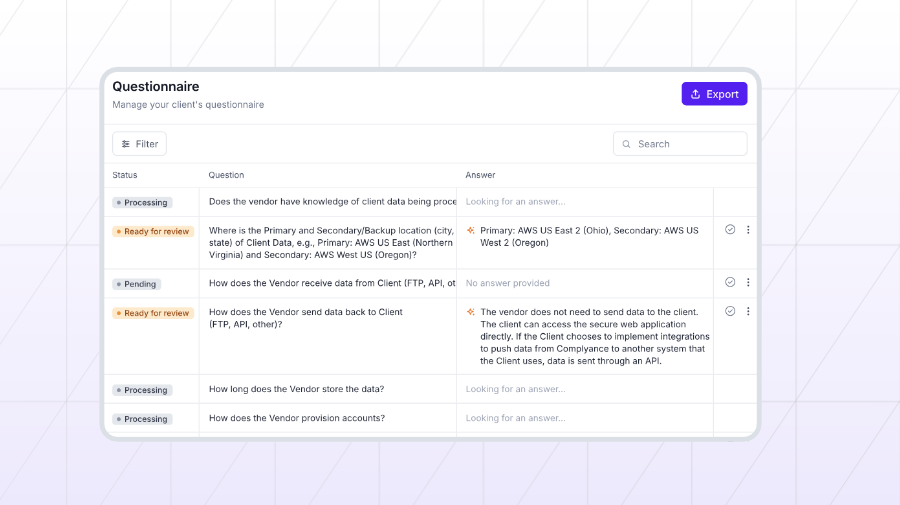
In Complyance, the Customer Trust module pairs a trust portal with AI drafting of answers to customer security questionnaires. The Customer Trust Agent drafts each answer from your approved answers first, then from the policies and controls held in the same platform where no approved answer covers the question. Your team sets which steps need sign-off, tailors each draft to the customer, and approves it before it goes out.
Run the same three checks on it as on any tool. If your policies and controls aren't in a platform yet, moving them there comes first, which is a larger project than setting up a questionnaire tool. Once they're in an Enterprise GRC platform, the same policies and controls feed your audits, your trust portal, and every questionnaire draft.
Where should you start?
Start with last year's questionnaires. Count how many arrived, list the questions you answered more than once, and note the policy or control each of those answers depends on.
Answers you can't tie to a current policy or control are where to start the upkeep, whatever you choose. Questions that came up from buyer after buyer are the ones worth publishing.
An answer a buyer can rely on says what a current policy or control does, and someone on your team has signed it. That's the standard to hold any tool to.
See how Complyance drafts questionnaire answers from the policies and controls your team already maintains.


