
Why an Integrated AI Platform Matters for GRC Teams
How connected agentic AI helps Enterprise GRC teams move from manual work to proactive risk management.
GRC teams are running out of runway. Compliance obligations have grown faster than headcount for the better part of a decade with multiple frameworks, a vendor risk program spanning hundreds or thousands of third parties, and an expectation of audit-readiness at any moment, all managed by a lean team.
An integrated AI platform doesn't just add automation to that landscape. It changes the architecture of how GRC work gets done.
Where AI Meets Daily GRC Work
The promise of AI in GRC is real, but it has been inconsistently delivered. Most platforms layer simple automations over the existing workflow and call it Agentic AI. The result is "AI" that can suggest, summarize, and draft, but it can't execute the work for you.
That distinction matters. GRC teams don't need a smarter way to do manual work. They need the manual work removed entirely.
An AI-native GRC platform is built differently. Rather than bolting a copilot onto the old process, it embeds purpose-built agents into the core GRC workflows and lets them run the work the way the team would: an agent responds to a trigger, runs the multi-step workflow autonomously, and hands back completed work, with the full context and suggested next steps attached, for the team to check rather than build from scratch. The team stops losing hours to execution and spends them on the judgment work that actually needs them.That only holds up in a GRC context because each agent is tightly scoped and governed at the agent level, with the criteria it applies, the review steps it follows, and the escalation it triggers all defined up front, so every output stays trustworthy and traceable.
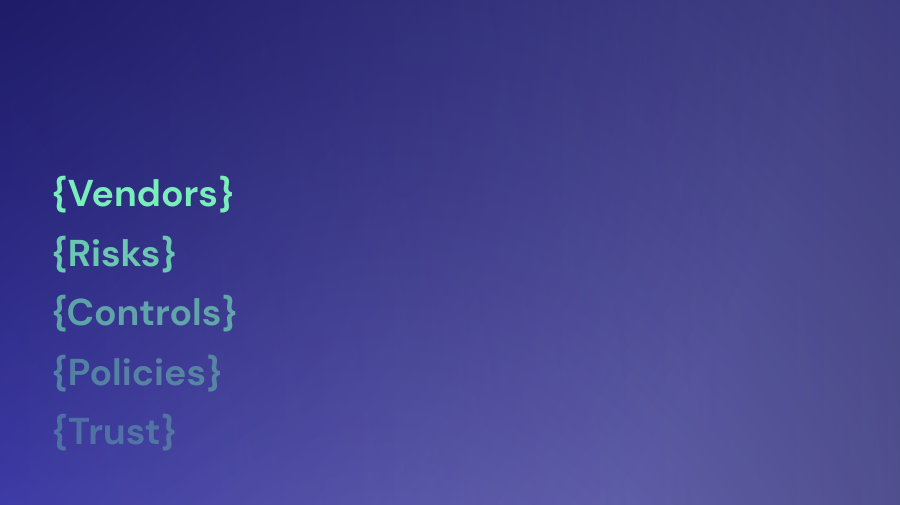
Complyance is built on this architecture: five modules, connected by shared data, with AI Agents embedded at the judgment-intensive steps across each one. Here's how that connection changes the work:
Vendors: TPRM is where GRC teams lose the most time: sending questionnaires, chasing responses, reviewing answers largely consistent with prior assessments, and manually recreating a risk record each time a finding surfaces.
Rather than running every step by hand, the team gets purpose-built agents at the stages that cost them the most. AI Intake receives a new vendor request, creates the record, and chases the business owner for any missing context, so the assessment is ready to run before anyone picks it up. Questionnaire Review then assesses the vendor's responses against the organization's risk criteria and pulls in external risk ratings scored against criticality and data access, handing the team a set of findings to review instead of a wall of raw answers.
When a serious finding surfaces, it doesn't stay in the vendor module. The Vendor Review Agent flags it; one click from GRC accepts the raise, and the Vendor Risk Creation Agent drafts a fully contextualized risk in the register, dynamically linked so if the finding updates, the risk updates.
Risks: Risk registers are often incomplete not because teams don't know what risks exist, but because capturing them requires manual effort where every control gap, vendor finding, or policy lapse needs to be recreated by hand.
Our Risk Agents change what happens after a risk is identified. Agents suggest mitigation steps and create actionable tasks from treatment plans, connecting risk identification to the remediation workflow without a separate manual step.
The payoff is a complete picture of the organization's risk posture in one place: where each risk comes from, how its remediation is tracking, and which areas are emerging as exposure shifts. Board reporting stops being a manual assembly job pulled together before each meeting, and the team can direct its effort at the risks that matter most, genuinely reducing risk rather than just recording it.
Controls: Controls management is one of the most complicated parts of a GRC program. Audit preparation means manually reviewing thousands of evidence items in a crunch, checking each one meets its requirement. Ongoing controls monitoring relies on point-in-time samples that cover a fraction of the real exposure points, and often only on a single day each year. It takes enormous time and still isn't efficient or complete.
AI Agents make the review continuous. The agent reviews evidence against the organization's own custom criteria, checking for exactly what the team would check for themselves, and flags gaps as findings, identifying precisely where evidence is missing or insufficient rather than returning a simple pass or fail. It's like having your GRC team reviewing your evidence 24/7, catching the same nuances they would.
The output isn't just time saved. Teams can see their compliance posture at any moment, not just in the weeks before an audit.
Policies: Most organizations carry a policy library that was inherited, built for audit readiness rather than operational accuracy, and has drifted further from the controls it was meant to support ever since.
Complyance's AI Agents change the drafting process at the source, rewriting policies against the organization's actual control list, not a standard template, and summarizing each one automatically for approvers and employees.
Policies that stay current and aligned to controls don't just reduce audit risk. They become the foundation for everything downstream, including how the organization responds when a customer asks whether it can be trusted with their data.
Trust: Third-party risk isn't one-directional; GRC teams spend time managing their own vendor risk and responding to incoming security questionnaires from customers, both drawing on the same underlying compliance data they've already documented.
Complyance's AI Agents pre-populate answers to incoming security questionnaires using the organization's own controls data, policy library, and approved answers, surfacing accurate, policy-aligned drafts for the team to review and approve instead of searching and writing from scratch.
The result is that the compliance work done to satisfy an auditor also satisfies a customer's due diligence process. The organization's documented practices become the source of truth in both directions.
Interconnectivity as Architecture, Not the Feature
The individual capabilities across each module are real and measurable on their own. But it's the architecture, the way every module connects through shared data, that makes the benefits compound, because each connection removes manual transfer work and adds visibility at the same time.
Controls link to evidence, so the evidence that satisfies each requirement is cross-mapped automatically, giving full, nuanced coverage across the program instead of re-collecting the same artifacts framework by framework. Vendor assessment findings link directly to the remediation tasks they generate, so the owner can resolve them with the full context already attached; and each vendor risk links back to the questionnaire finding that raised it, making exposure from any vendor simple to trace in both directions. Risks link out to every control that mitigates them, so a control failure immediately surfaces the risk exposure it puts at stake.
Built this way, the data GRC teams generate through daily work builds into an accurate picture of Enterprise risk posture. Most Enterprise programs hold this interconnected picture up as a future-state vision. An AI-native platform, the agents and the architecture that links them, operationalizes it today, turning what stays aspirational elsewhere into how the program already runs.
GRC teams don't need more places to manage information. They need a system where AI removes the manual transfer work between those places, and where agents handle the judgment-intensive review that today requires human hours at every step. And when the criteria the Agents apply are codified, improving the program becomes a plain-language update, applied consistently across every vendor, every control, every assessment from that point forward.
That's what integrated Agentic AI delivers. Not a smarter way to do the manual work, but the removal of it entirely. For GRC teams, that's the difference between running to keep up and getting ahead of risk.



