
GRC Problems, Solved: Vendor Triage and Assessment
Once a vendor is in the queue, the next decision sounds simple: how do we assess this one? What do we need to ask, and how deep do we need to go? It looks like something you can answer from the vendor type alone.
It used to be. But vendors increasingly sit inside core systems, run on AI, and lean on long chains of sub-processors, and the type on the intake form tells you less and less about the real risk. Getting the right information from the right vendors, and not drowning the rest, matters more than it used to.
The catch is that you can't scope the review until you understand what the vendor actually does and how critical it is, and the business owner rarely gives you enough to know. So teams face a choice: research every vendor before deciding what to send, which is thorough but slow, or send everyone the same long questionnaire, which is fast but blunt. A questionnaire that asks far more than a given vendor needs comes back slower and thinner, or gets redirected to a trust portal you then have to work through by hand. The tighter, more tailored questionnaire is almost always the better one. It is just expensive to build, vendor by vendor.
There are a handful of ways teams handle this, from a single standard questionnaire to a fully tailored, AI-driven assessment. Here's how each one works, and where it holds up.
Option one: A standard questionnaire, with little or no triage
The simplest approach is one standard questionnaire, or a small set split by broad vendor type such as software, hardware, or services, sent to every vendor that needs a review. It usually goes out as a spreadsheet, which is easy to send but hard to tailor: trimming the questions to what's relevant for a given vendor means either fiddly tab logic or a how-to guide the vendor has to read first. Supporting documents come back separately, so there's still a fair bit of back and forth. The one real efficiency sits at the front, where a quick screen can rule out the vendors that don't need a full assessment at all.
Pros: It's quick to stand up and easy to run, and there's no per-vendor decision to make before anything goes out. Screening out the vendors that don't need a full review genuinely saves time. And because it's the same questionnaire each time, the responses are at least consistent and comparable across vendors.
Cons: The cost lands on relevance. A questionnaire built to cover every vendor asks far more than most need, and a vendor facing eighty questions that half apply responds more slowly, in less detail, or just points you to a trust portal to comb through. Splitting by broad vendor type only helps so much, because two software vendors can carry very different risk once you look at the data and access involved. And a reviewer still reads every response by hand.
For programs with steady, low-complexity vendors, a standard questionnaire is a defensible starting point, and the up-front screen-out is a genuine saving. It strains as soon as risk varies from one vendor to the next, because a one-size questionnaire trades tailoring for simplicity and pays for it in the quality of what comes back.
Option two: Manual research and tailored questionnaires
A step up is to do some research once the request lands, then tailor what you send. The reviewer looks into what the vendor actually does, what data and access are involved, and how critical the relationship is, and uses that to pick or build a tighter questionnaire and set a rough risk tier. The questionnaire fits the vendor far more closely, which tends to bring back better answers, faster, because the vendor isn't wading through questions that don't apply. The work is the trade-off: the research and tailoring take real time on every vendor, and the tiering logic takes effort to set up and keep current.
Pros: Tailoring the questionnaire to the vendor lifts both the quality and the speed of responses, because vendors answer what clearly applies to them. The tiering gives the team a defensible reason for how deep each review goes. And the reviewer builds real context on the vendor early, which pays off through the rest of the assessment.
Cons: It's time-consuming, and the per-vendor research is hard to sustain as volume climbs. The tiering is only as good as the logic the team builds and maintains, and a wrong call here sends the wrong questionnaire and surfaces the wrong information. Past a certain number of new vendors a week, the pre-work alone outpaces what the team can absorb.
This is where many maturing programs sit: better responses and a defensible tier in exchange for real reviewer time. It works well at moderate volume, and begins to strain when the research burden per vendor collides with a growing vendor list.
Option three: A dedicated TPRM tool with tiering and risk scoring
Many teams bring in a dedicated TPRM tool to systematize this. The tool adds structured tiering logic by risk level, automated reminders so chasing vendors isn't a manual job, and a portal where vendors upload documents directly, so everything is collected and centralized in one place instead of scattered across inboxes. Some also include automated risk scoring to support the pre-triage, giving the team a starting read on a vendor before a person weighs in. It's more setup than a spreadsheet, and the tiering is still only as good as the logic and inputs behind it, but it turns a manual routine into a repeatable, centralized process.
Pros: Centralization is the big win: questionnaires, documents, reminders, and scores all live in one place, and the chasing runs itself. Built-in tiering and automated scoring give the team a consistent, faster starting point for how deep to go. And the audit trail a dedicated tool produces makes the triage decision easy to evidence later.
Cons: It takes setup and budget, and the tiering logic still reflects the rules and inputs configured into it, so it can mis-tier a vendor whose real risk doesn't match its category. The scoring helps but rarely tells the whole story on its own, and a reviewer still confirms the call and reads the responses. Like any fixed logic, it adapts only as fast as someone maintains it.
A solid fit for teams that want consistency, centralization, and less manual chasing, and have the budget to invest. It moves the program from a manual routine to a repeatable process, while the depth-of-review decision still leans on the quality of the logic behind it.
Option four: An AI agent for TPRM
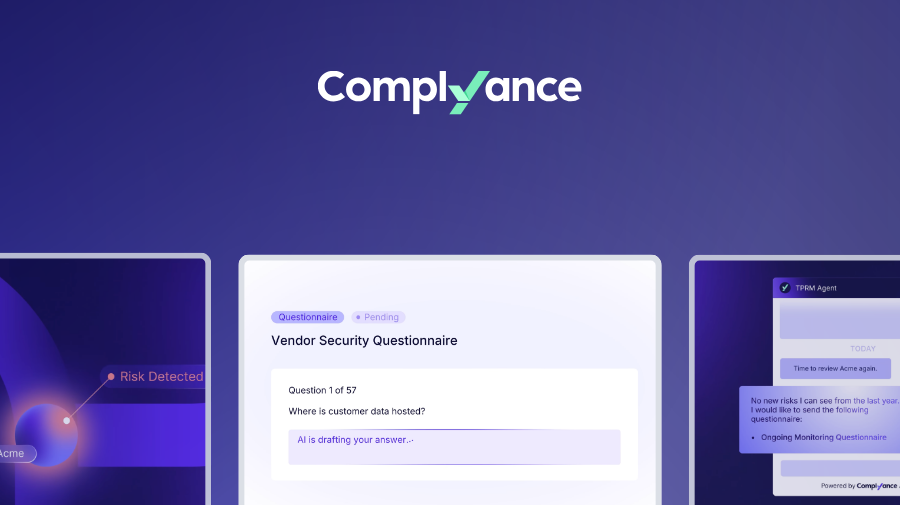
The furthest step changes who does the triage work. When a new vendor request comes in, a TPRM Agent runs an outside-in investigation, drawing on public information about the vendor, any previous questionnaires on file, and the vendor's trust portal, and sets an objective risk score. From that and the vendor's internal criticality, it suggests a tailored assessment pathway: a criticality tier and a questionnaire built for that specific vendor. The questionnaire itself carries tiering logic, adapting as documents are uploaded and gaps are identified, so each vendor effectively gets a custom assessment instead of a fixed template. The team sets the governance for what the agent decides on its own and what it routes back for a human to sign off.
Pros: Every vendor gets a tailored assessment without a reviewer spending the week researching first, so response rates and completeness climb because vendors only answer what genuinely applies. The research and scoring happen before a person opens the record, and the in-questionnaire logic keeps adapting as evidence comes in, closing gaps a fixed questionnaire would miss. It scales with vendor volume, not reviewer hours.
Cons: It needs the scaffolding around it: defined criticality criteria, a questionnaire library for the agent to draw on, and clear thresholds for what it can progress versus what needs a human decision. That setup is real work, and it has to reflect the organization's actual risk appetite to be trusted.
The highest setup effort, but the only approach that gives each vendor a genuinely tailored assessment without the per-vendor research burden. It suits teams whose vendor volume and complexity have outgrown manual triage, or who can see that point coming.
.png)
Which one is right for you?
The right approach tracks two things: how many vendors you take on, and how much they vary. If your vendors are fairly uniform and low-complexity, a standard questionnaire with a quick screen-out keeps things simple, and the hit to response quality is bearable. As soon as risk varies meaningfully from one vendor to the next, tailoring starts to pay for itself in the quality and speed of what comes back.
Manual research buys you that tailoring with no new tooling, and works until the per-vendor pre-work collides with volume. A dedicated TPRM tool absorbs the chasing and centralizes everything, which earns its budget once the manual routine stops scaling. An AI agent is the option that holds up when both volume and complexity are high, because the research and tailoring stop depending on reviewer hours.
The throughline is that the depth of a review has always come down to how much time the team had to scope it. Each step up the ladder buys back more of that time, and spends less of it deciding what to ask.
Deciding how to assess a vendor has always come down to how much time the team had before the questionnaire went out. Whichever approach fits yours, the goal is the same: the right questions reaching the right vendors, so what comes back is actually worth assessing.
See what the agent-led version looks like → Book a demo
Triage decides what gets sent. What comes next is the wait: how long vendors take to respond, and how much reviewer time goes into chasing them before the assessment can start. Part 3: The Real Cost of Vendor Questionnaires: It's Not the Questions, It's the Wait (Coming Soon)



